
Grab Bars and Bathroom Safety Equipment: A Real Buying and Installation Guide
As an Amazon Associate, I earn from qualifying purchases.
Grab bars are one of the cheapest, most effective home safety changes you can make, and also one of the most commonly installed incorrectly. Given how much of our home safety and fall-risk content on this site points back to the bathroom specifically, it’s worth walking through what actually makes a grab bar work, because a poorly mounted one can give a false sense of security that’s arguably worse than having none at all.
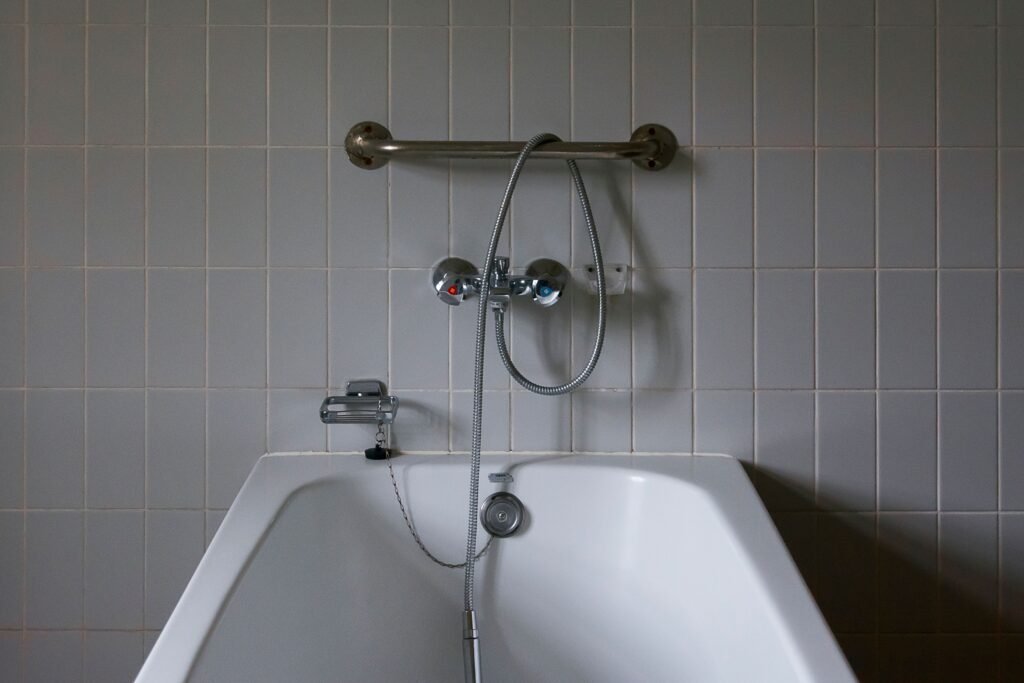
Mounting a grab bar into drywall alone is dangerous: drywall anchors support only 10-15 lbs, nowhere near what’s needed during an actual fall.
The types of grab bars, and which one actually matters most
Straight horizontal bars (ranging roughly 12 to 42 inches) are the most versatile option, useful along shower walls and beside the toilet for lateral support while standing or moving.
Vertical bars are mounted upright at transition points (a shower entrance, or beside the toilet) specifically to help someone pull themselves up from a seated position, which uses different muscles and leverage than a horizontal bar.
Angled or diagonal bars, mounted at roughly 30-45 degrees, are specifically recommended by occupational therapists as the single best option for toilet-side installation, since the angle accommodates both the “pushing down to sit” and “pulling up to stand” motions in one bar.
L-shaped bars combine a horizontal and vertical section in one unit, useful for corners or spots where multi-directional support matters.
Flip-up bars pivot against the wall beside a toilet, folding out of the way when not needed: useful in a tighter bathroom or when the toilet is shared with someone who doesn’t need the support.
One important warning: suction-cup grab bars, the kind that don’t require any drilling, should never be relied on as a primary safety device. They can lose suction without warning, and marketing that presents them as a permanent solution is misleading: treat them as, at best, a very temporary aid, not something to trust with your parent’s full body weight.
Where they actually need to go
Placement matters as much as the bars themselves. Beside the toilet, the general guideline is a 42-inch horizontal bar mounted on the wall beside the toilet, about 12 inches from the rear wall, at a height of 33 to 36 inches off the floor: plus a vertical bar in the 33-56 inch range for the standing motion. Inside the shower or tub, horizontal bars at standing height (33-36 inches) should be paired with an additional bar roughly 8-10 inches above the tub rim for seated support, along with a vertical bar at the entrance. Covering both the side and back walls of a shower, rather than installing a single bar, closes the gaps between “safety zones” that a lot of installations miss: a single bar often leaves your parent unsupported during part of the actual movement (entering, turning, sitting, standing) rather than all of it.
The installation detail that actually matters most
Here’s the single biggest mistake people make, and it’s worth taking seriously: mounting a grab bar into drywall alone is dangerous, not just suboptimal. Drywall-only anchors typically support only 10-15 pounds per screw: nowhere near enough to hold someone’s body weight, and critically, the forces involved in an actual fall or stumble can be 2-3 times a person’s static body weight due to the dynamic force of a sudden grab. A bar that looks secure when you tug on it gently can fail completely under the sudden force of someone actually catching themselves during a fall: which is exactly the moment it needs to work.
The right approach is mounting directly into wall studs (typically spaced 16 inches apart, locatable with an inexpensive stud finder), using appropriately sized wood screws (at minimum #12 x 2.5 inch), and sealing around the mounting holes with silicone caulk to prevent water damage over time. When studs aren’t available in the exact spot needed, heavy-duty mounting plates or toggle bolts rated for 250+ pounds are a legitimate alternative, but plain drywall screws or anchors are not, regardless of how the bar looks once installed. Look for bars specifically rated to hold at least 500 pounds, which accounts for that dynamic force multiplier rather than just static body weight.
If you’re not confident doing this yourself, this is genuinely worth paying for professional installation rather than risking it: the cost difference is real, but so is the consequence of a bar that fails at the exact moment it’s needed.
What it costs
Hardware alone for DIY installation typically runs $25-80 per bar, with mid-range quality bars generally $25-60 each. Professional installation adds $100-300 per bar depending on your area and whether stud placement cooperates with where the bar needs to go. A full bathroom setup with 4-6 properly placed bars, professionally installed, generally runs $400-800 total: a genuinely modest cost relative to the fall-prevention value, especially compared to some of the larger home modifications covered elsewhere on this site, like walk-in tubs or stairlifts.
Check the current price on Amazon →
Does insurance help?
Traditional Medicare coverage for grab bars is limited, though some Medicare Advantage plans and state Medicaid Home and Community-Based Services (HCBS) waiver programs may help cover installation costs for qualifying beneficiaries: worth checking your parent’s specific plan or your state’s Medicaid waiver program directly, since coverage varies significantly.
The bottom line
Grab bars are inexpensive enough that cost usually isn’t the real barrier: installation quality is. A cheap set of properly mounted bars into studs, at the right height and placement, genuinely protects against one of the most common and dangerous fall scenarios in an older adult’s home. A more expensive set mounted into bare drywall provides a false sense of security that could make things worse, not better, if your parent leans on it with full confidence during an actual fall.
Sources: Porch Light at Home: Grab Bar Installation for Seniors 2026: Complete Placement, Types & Cost Guide






6 Comments