
Adapting a Kitchen for Reduced Mobility: What Helps, From Free Fixes to Full Renovations
This article contains affiliate links. As an Amazon Associate I earn from qualifying purchases.
Kitchens are a prime location for falls in any home, older adult or not: spills, hard flooring, reaching and bending all combine in one room more than almost anywhere else in the house. For a parent with reduced mobility, though, the everyday act of cooking can quietly become one of the riskiest parts of the day, and one of the first independent activities to slip away if the kitchen itself isn’t set up to support it. The good news is that meaningful kitchen adaptations for the elderly don’t require a full renovation: there’s a real, useful range from completely free adjustments up to bigger structural changes, and most families can start at the low end before deciding whether more is needed.
Quick answer: The best kitchen adaptations for the elderly start for free: move everyday items to waist height, clear the counters and add a stool for seated prep. Next come cheap safety fixes like non-slip mats, brighter lighting and easy-grip handles. Bigger changes, such as lower counters, a wall oven or pull-out storage, can be planned over time.
Start with what costs nothing at all
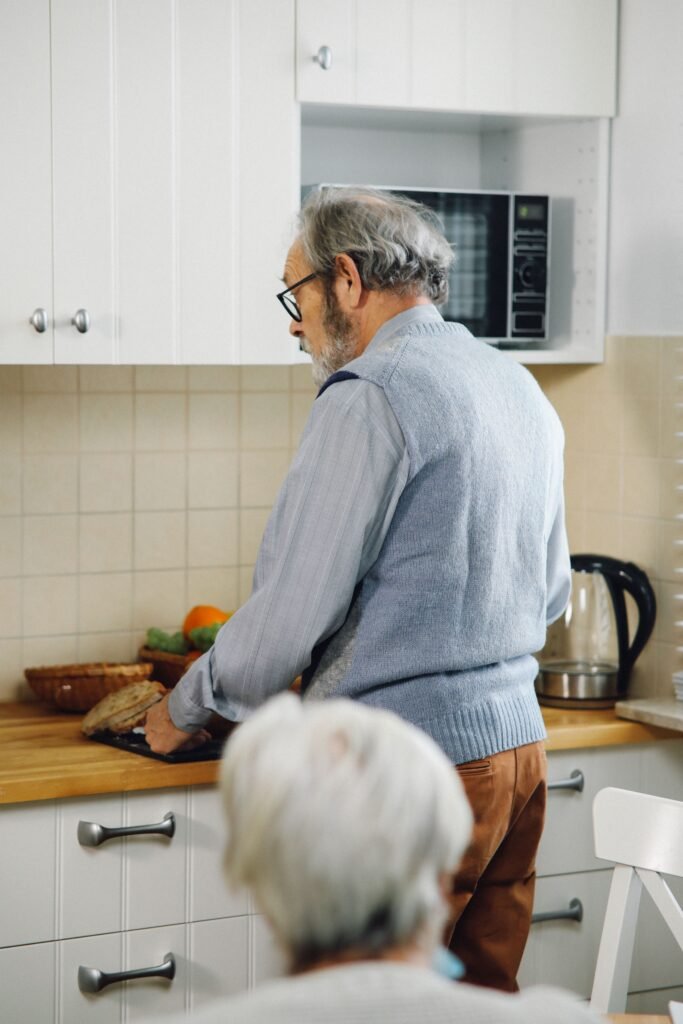
Before spending anything, simple reorganization does a surprising amount of work. Moving high-use items (everyday dishes, the coffee maker, commonly used pots) to waist or chest height keeps your parent from bending down to low cabinets or reaching up to high ones, both of which are common triggers for a loss of balance. Keeping countertops clear of clutter reduces both visual confusion and the physical obstacles your parent has to navigate around while carrying something. And something as simple as placing a sturdy stool in the kitchen gives your parent the option to sit while doing food prep tasks that don’t require standing: chopping vegetables, mixing, or anything at the counter that can just as easily be done seated.
Budget-friendly updates that make a real difference
Once the free reorganizing is done, a modest budget opens up several genuinely effective options. Slip-resistant mats placed strategically in front of the sink, stove, and any other spot where spills are likely add real traction exactly where it’s needed most, without the cost of replacing the flooring itself. Replacing standard cabinet knobs with larger handles that have rounded edges makes cabinets easier to grip and open for a parent with arthritis or reduced hand strength: a small, inexpensive swap that removes a daily point of friction. Adding LED lighting under cabinets or along baseboards improves visibility for close food-prep work and helps your parent see spills or obstacles on the floor before they become a hazard; motion-activated lighting options take this a step further by removing the need to find and press a switch at all. Lever-style handles on faucets, and paddle-style light switches in place of small toggle switches, are similarly inexpensive changes that reduce the fine hand strength and grip needed for basic daily tasks.
Flooring: a specific hazard worth addressing directly
If your parent’s kitchen currently has smooth, slick tile or worn linoleum, this is worth prioritizing over more cosmetic changes. Non-slip ceramic tile or water-resistant luxury vinyl flooring genuinely improves traction compared to slicker surfaces, particularly in a room where spills happen regularly. It’s a real cost, but it’s also one of the few changes that directly reduces fall risk rather than simply making tasks more convenient: worth weighing against some of the appliance upgrades below if you have to prioritize.
Bigger renovations, when they’re worth it
For a kitchen that needs more than surface-level fixes, several structural changes make a meaningful difference, though at real cost. Lowering counter height by a few inches from standard accommodates food preparation while seated, which matters significantly if your parent uses a wheelchair or has difficulty standing for extended periods. Around any island, counter, or cabinet run, a minimum of 42 inches of clearance is the general guideline for comfortable wheelchair maneuverability: worth measuring your parent’s current kitchen against before assuming it already works.
On the appliance side, a wall oven installed at an accessible height (rather than a standard under-counter oven requiring a deep bend to reach the back) reduces bending and reaching considerably, and a pull-out counter or shelf positioned beneath it gives a safe place to rest a hot dish immediately after removing it, rather than carrying it across the kitchen. A smooth-top range with front-mounted knobs, instead of knobs at the back behind hot burners, is both easier to reach and safer to operate. A side-by-side refrigerator style tends to be more accessible than a top-freezer or bottom-freezer model, since both fresh and frozen sections stay within a reachable height range rather than requiring a bend to the floor or a reach overhead.
Storage upgrades: pull-out drawers, pull-down shelving systems, and lazy Susans or corner cabinet organizers that bring items forward automatically: meaningfully reduce the reaching and bending that standard fixed shelving requires, and are a reasonable middle-cost option between the smallest fixes and a full layout renovation.
Adaptive kitchen tools worth having
Alongside changes to the room itself, a few inexpensive tools make everyday kitchen tasks easier and safer for a parent with arthritis, weak grip or limited reach:
- A reacher grabber tool for lightweight items on higher shelves, so your parent doesn’t need to climb a step stool.
- An electric jar opener that removes stubborn lids without any twisting or grip strength.
- Built-up handle utensils with wide, soft grips that are easier to hold for anyone with arthritis or a tremor.
- A rocker knife that cuts with a gentle rocking motion and can be used with one hand.
- Motion-sensor LED under-cabinet lights that switch on automatically and light up the counter and floor.
Kitchen adaptations for the elderly: how to decide where to start
There’s no need to do everything at once, and most families genuinely shouldn’t try to. Start with the free reorganization and the cheapest safety fixes (non-slip mats, better lighting, easier-to-grip handles) since these address real risk at minimal cost and can be done in an afternoon. From there, prioritize flooring if the current surface is genuinely slick, since it’s one of the more direct fall-risk interventions available. Appliance and layout changes are worth planning for if your parent intends to stay in this home long-term and cooking remains an activity they want to keep doing independently, but they can be staged over time rather than done as one large renovation, starting with whichever single change (a wall oven, a lowered counter section, better cabinet storage) would solve your parent’s most immediate daily frustration.
Sources: Age in Place HQ: Kitchen Modifications for Seniors: Easy-Reach Cabinets, Adaptive Tools & Safety Tips (2026), Mr. Handyman: A Guide to Aging in Place Kitchen Design, ElderLife Financial: Kitchen Update Tips for Seniors for Aging in Place






3 Comments